Sacramental Programmes
The English word "sacrament" is derived indirectly from the EcclesiasticalLatin sacrāmentum, from Latin sacrō ("hallow, consecrate"), from sacer ("sacred, holy"). In Ancient Rome, the term meant a soldier's oath of allegiance, and also a sacred rite. Tertullian, a third-century Christian writer, suggested that, just as the soldier's oath was a sign of the beginning of a new life, so too was initiation into the Christian community through Baptism and Eucharist.
(ref. Roo, William A. van (1992). The Christian Sacrament. Roma: Ed. Pontificia Univ. Gregoriana. p. 37. ISBN 8876526528)
From the beginning of Christianity, the Church has celebrated some of the important ‘moments’ or milestones in our lives. These are peak moments in our lives and for each one we have public rituals in the Church – known as Sacraments – when we ask to be blessed with God’s grace.
The Church has singled out seven of these important occasions when, in words and symbolic actions, we publicly celebrate God being with us (Emmanuel). These ‘sacraments’ are:
- Baptism, Confirmation and Eucharist (the sacraments of initiation);
- Penance/Reconciliation and Anointing (the sacraments of healing);
- Marriage and Orders/Ordination (the sacraments of commitment).
Sacraments in the Catholic Church are occasions for experiencing God’s saving presence. When celebrated, the Sacraments are visible outward expressions of God touching us with His healing grace.
For further information on each Sacrament, please follow the links below.
Should you require any further information please contact either Fr Gildea or Deacon Jim McGraw.
Eucharist is the Greek word for giving thanks. When we gather to celebrate the Eucharist, we give thanks for all that God has done and continues to do for us through the death and resurrection of Jesus. In the Eucharist the crucified and risen Jesus reaches down to us and lifts us up to join him in offering ourselves to God the Father. It is a complete offering of ‘self’ into God’s hands.
Click on the image for more. ➡️
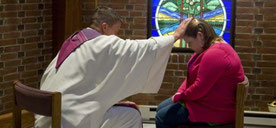
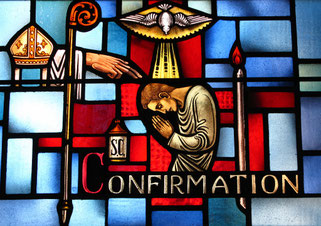
The Sacrament of Confirmation completes the process of our initiation into the Church.
In the Confirmation ceremony the Bishop calls upon the Holy Spirit to strengthen our faith and our commitment to following Christ by the laying on of hands and anointing with sacred Chrism. The ceremony may take place in our own parish, or may be consolidated into a larger group at a different parish. Numbers will dictate how and where the ceremony will take place.
Click for more. ➡️
For people who are struggling with pain, illness or disability, the Church offers the Sacrament of the Sick. Once referred to as Extreme Unction and ministered only to those in danger of death, it is a prayer seeking healing and strength. Through this sacrament people receive forgiveness for their sins and comfort in their suffering; they are restored in spirit; and, sometimes, they even experience the return of physical health. More ➡️
Anyone who has not already been baptised can receive the sacrament of baptism in the Catholic Church. There are no age restrictions.
Infants and small children up to the age of 7 years old, can be baptised by a Bishop, Priest or Deacon. Children over the age of 7, and adults wishing to be baptised are required to undergo a programme of instruction known as R.C.I.A. (Right of Christian Initiation for Adults).
⬅️Click the image for more.

In this sacrament – also known as ‘going to confession’ – we are invited to share the peace and joy that comes with letting go of our sins, hearing that we are forgiven and beginning anew in the Sacrament of Reconciliation.
⬅️Click for more.
In the love that a husband and wife have for each other, the Church sees a sign or ‘sacrament’ of God’s love for us. The image of a bride and groom is used frequently to describe God’s commitment to His people (His bride). The image of a wedding feast or banquet is used also to describe the happiness that awaits us in heaven. If you are planning to get married you are required by the Church to set aside some time to prepare for the important step you are about to take. More ⬅️

Ordination (or Holy Orders) is the Sacrament for those who have been called to a special ministry of service in the Church.
An ordained minister undergoes an intense period of training (up to six years for a priest, five for a Deacon). By his life the Minister strives to be a special sign of Christ’s presence and to convey Christ’s compassion and love to all the people he is called to serve. More ⬅️